
The enduring beauty of an antique turquoise and diamond ring
There’s something quietly arresting about turquoise. Its colour, neither purely blue nor green, but somewhere between sky and sea, has captivated humankind for thousands of years. When set alongside diamonds in an antique ring, that soft, luminous hue becomes part of something even more compelling: dialogue between colour, light and history.
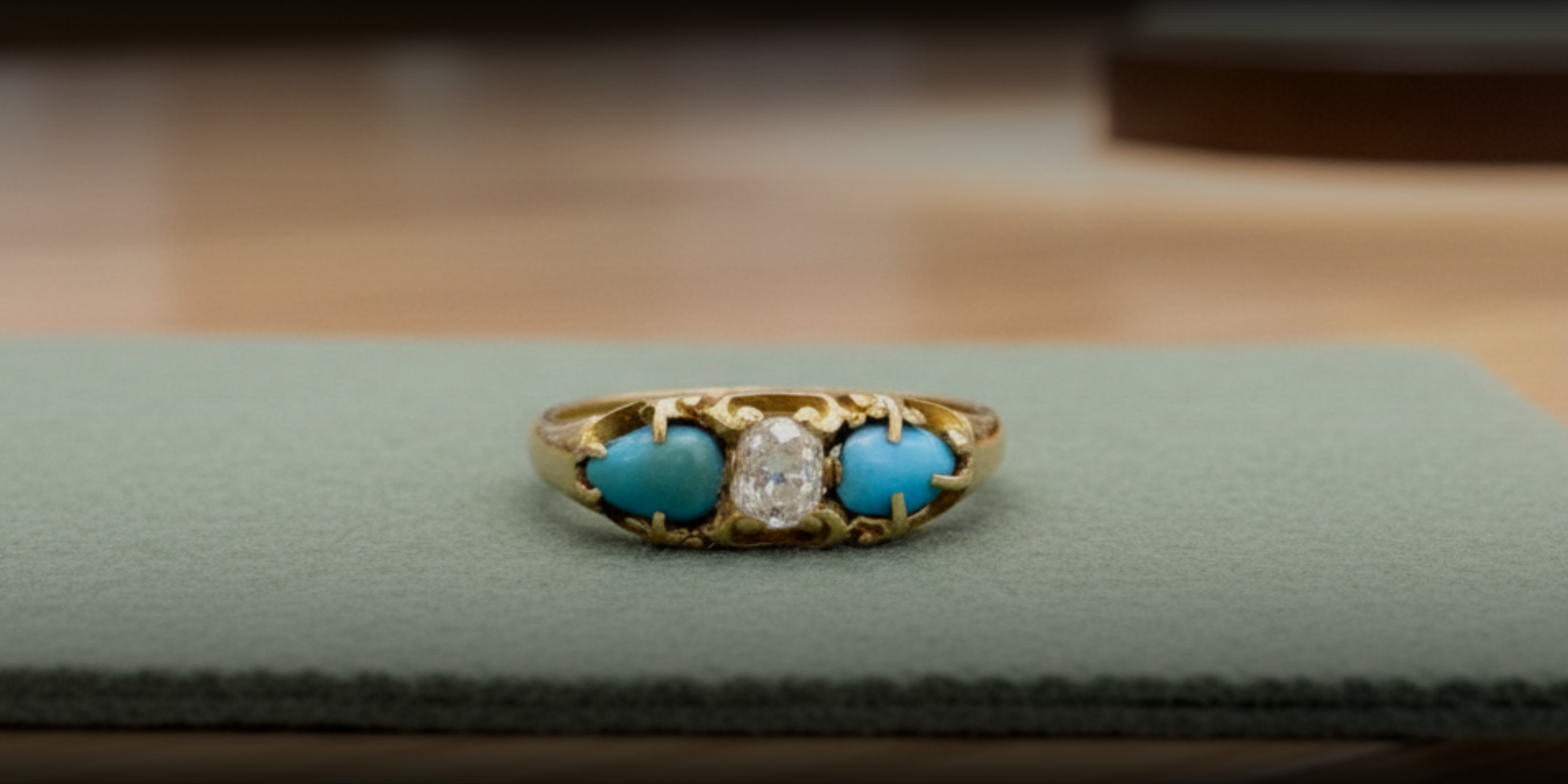
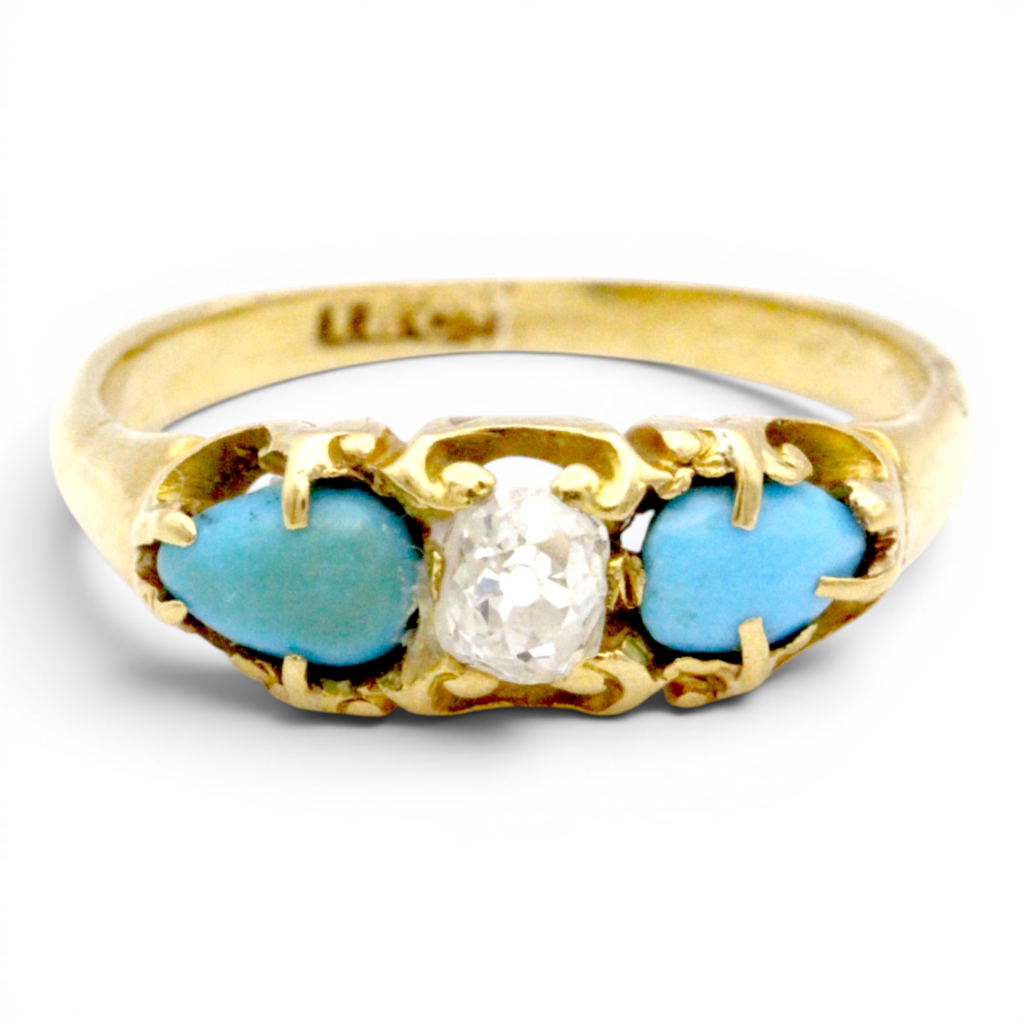
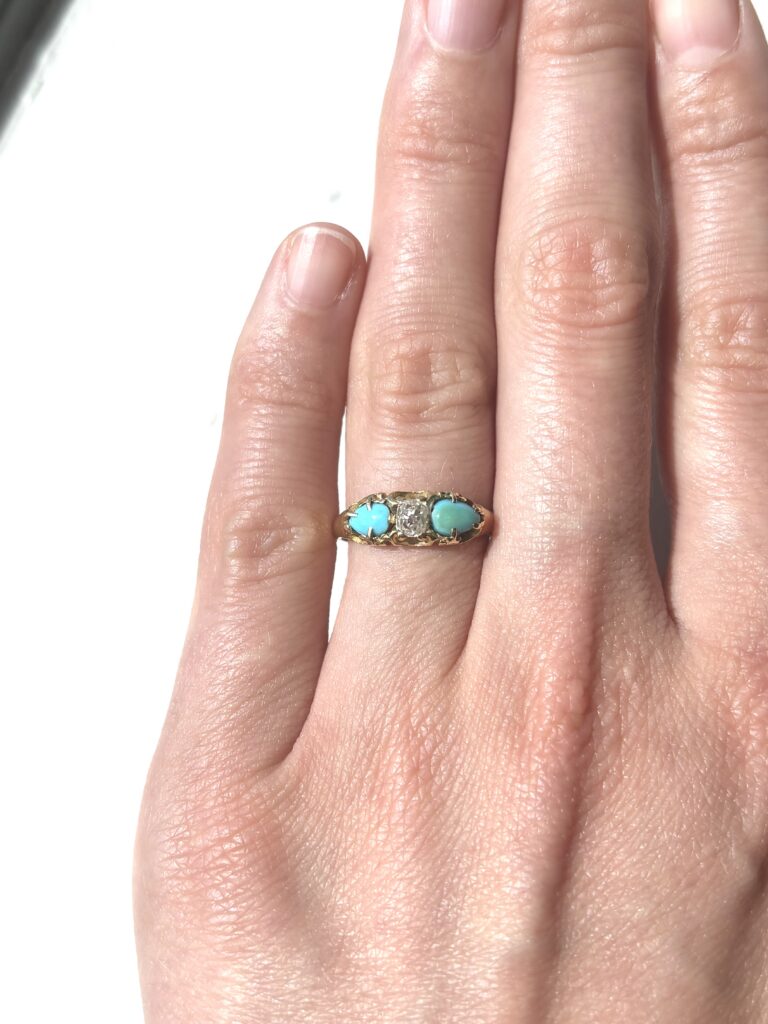
The antique turquoise and diamond ring at the heart of this piece exemplifies that balance. Its composition feels both elegant and timeless, with tranquil presence of turquoise enriched by the brilliance of diamonds. It is a design rooted in tradition, yet perfectly suited to modern sensibilities.
One of the world’s oldest gemstones
Turquoise is among the earliest gemstones ever used in jewellery, with evidence of its adornment dating back 7,000 years. Archaeological discoveries show it was prized by ancient Egyptians, who mined it in the Sinai Peninsular and used it in jewellery, amulets and ceremonial objects.
At the same time, Persian civilisation developed a deep appreciation for the gem, particularly stones from the famed Nishapur mines in present-day Iran. These stones became the benchmark for quality and were associated symbolically with the heavens.
Across continents, turquoise emerged as a universal stone of significance. From Egyptian tombs to Persian courts and later to cultures in Asia and the Americas, it was valued not just for decoration, but for meaning bringing together art, spirituality and status.
A stone of meaning and symbolism
Turquoise carries a depth and symbolism that only few other gemstones hold. Across many cultures, it had long been considered a stone of protection, worn as a talisman to guard against harm or misfortune.
In addition to protection, turquoise was also believed to bring good fortune and health. For centuries, it appeared in amulets, ceremonial objects, and personal jewellery intended to accompany the wearer through life’s uncertainties.
Even its name reflects its journey through history. The word “turquoise” derives from the French pierre turquoise, meaning “Turkish stone”, referencing the trade routes through which the gem reached Europe from Persian sources.
By the time turquoise became established in European jewellery, it already carried a rich legacy that lent additional meaning to every piece in which it was set.
Turquoise in antique jewellery
Turquoise found particular favour in 19th-century European jewellery, especially during the Victorian era. This was a period when jewellery was often deeply symbolic, designed to convey emotion as much as beauty.
Its soft, opaque surface, typically shaped into a smooth cabochon, made turquoise ideally suited to decorative compositions that emphasised colour over brilliance. Jewellery frequently incorporated it into cluster or halo designs, pairing it with diamonds to create contrast and visual balance.
The light and sparkle of a diamond provided an ideal counterpart to turquoise’s calm, saturated tone. This interplay between radiance and stillness is one of the defining qualities of antique turquoise and diamond rings, giving them a distinctive character that differs markedly from modern gemstone jewellery.
Craftsmanship and composition
Antique rings from the 19th and early 20th centuries were largely crafted by hand. Each element was completed individually rather than cast in uniform moulds from the shaping of the gold to the setting of the stones.
This process lends antique pieces a subtle individuality. No two are alike and small variations in detail become part of their charm. In turquoise rings, the gemstone itself further reinforces this uniqueness. Each stone displays its own tone and surface character, making every ring inherently one-of-a-kind.
Turquoise is also distinctive in how it is cut. As before mentioned, turquoise is typically polished into a domed cabochon, unlike diamonds which are faceted to maximise brilliance. This enhance the richness of its colour and allows the viewer to focus on its natural beauty rather than reflected light.
A jewel that carries time
What makes an antique turquoise and diamond ring so compelling is not simply its aesthetic appeal, but its sense of continuity. It connects the wearer to an unbroken history of craftsmanship and adornment that stretches from ancient civilisations to the present day.
Turquoise has always been more than a decorative stone. It has represented protection, fortune, and the natural world itself. When combined with diamonds and shaped by the hands of past artisans, it becomes something deeply evocative: a piece of jewellery that carries both history and significance.
In a contemporary context, a ring like this offers rare authenticity, individuality and a tangible link to the past. It’s not just an accessory but an heirloom in the making.
Sources:
https://www.gemselect.com/gem-info/turquoise/turquoise-info.php; https://buddhastoneshop.com/blogs/news/turquoise-jewelry; https://www.gia.edu/turquoise-history-lore; https://www.gemsociety.org/article/history-legend-turquoise-gems-yore/; https://en.wikipedia.org/wiki/Turquoise;